1) What “legal to import” really means (and what customs actually checks)
When buyers say “legal to import,” they usually mean three different things:
- Product compliance: the excavator meets safety and environmental rules (CE/UKCA, emissions, noise).
- Border compliance: the paperwork matches the goods (correct codes, correct importer details, correct declarations).
- Market compliance: the machine can be sold and used where the customer operates (extra local rules, jobsite rules, city/state restrictions).
Customs doesn’t “test-drive” an excavator. They check documents, labels, and traceability. If something looks off—wrong engine label, missing Declaration of Conformity, suspicious certificates—containers get held. And once a shipment is flagged, the next few shipments often get extra attention too.
2) Quick definition: “small excavator” and why classification matters
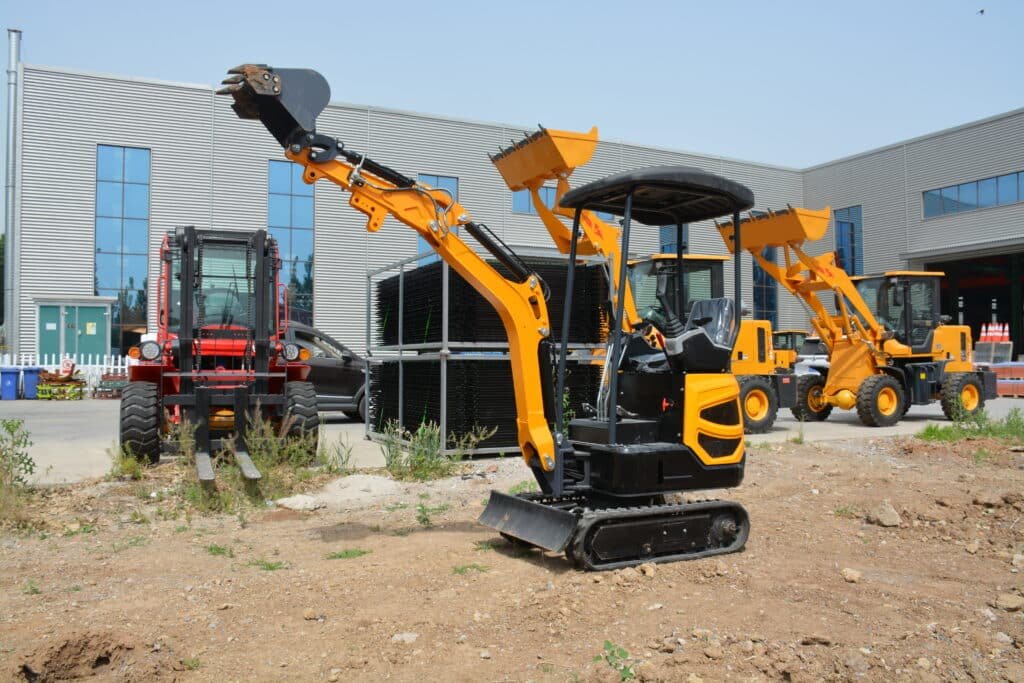
“Small excavator” usually means mini/compact excavators like 1–6 tons (sometimes up to ~8 tons). The exact size matters because:
- Emissions rules depend on engine power class (kW).
- Noise and labeling requirements can vary by equipment category.
- Tariff classification (HS/HTS/TARIC) must match the actual machine type (crawler/wheel, 360° revolving superstructure, attachments, etc.).
If the HS/HTS code is wrong, it’s not just a tax issue—customs can treat it like a compliance red flag.
3) Europe: the 3 big compliance pillars (CE safety, emissions, noise)
For the EU/EEA, think of it like a 3-lock door:
- Safety / CE marking (machinery safety rules)
- Emissions (Stage V for non-road engines)
- Noise (Outdoor Noise Directive for certain equipment categories)
If one lock isn’t satisfied, the machine can be stopped at the border or blocked from legal sale.
4) Europe: CE marking for mini excavators (Machinery Directive vs. new Machinery Regulation)
The key rule
Mini excavators are “machinery,” so they need CE compliance under EU machinery rules. The long-standing framework is the Machinery Directive 2006/42/EC. The EU has also adopted a new Machinery Regulation (EU) 2023/1230, which applies from 20 January 2027.
What this means in real life (2026):
- Most excavators placed on the EU market today still follow the Machinery Directive approach and harmonised standards.
- Importers should already ask suppliers how they’re preparing for the 2027 Regulation change, because documentation and “safety + digital” expectations are getting tighter.
What CE compliance usually includes (plain-English version)
For a mini excavator, a compliant CE package typically involves:
- Risk assessment (hazards: crush points, hydraulics, rollover, unexpected start, maintenance access, etc.)
- Technical file (design info + calculations + test evidence + standards used)
- EU Declaration of Conformity (DoC)
- CE marking on the machine
- User manual + safety instructions in the required EU language(s) of the destination market
A practical detail that gets missed: the Declaration of Conformity and technical documentation must be retained for at least 10 years after the product is placed on the market. EU guidance highlights this record-retention expectation.
“Importer responsibilities” in the EU are real
EU rules treat importers/distributors as “economic operators,” not passive middlemen. Importers are expected to help ensure only compliant CE-marked products are placed on the market.
In simple terms: if the manufacturer is outside the EU, the importer can’t just say “the factory promised it.” The importer should be able to show the DoC and key compliance evidence if market surveillance asks.
Practical tip: A serious importer keeps a “compliance folder” per model, per year: DoC, key test summaries, engine evidence, noise evidence (if applicable), serial number list, and shipment documents.
5) Europe: Stage V emissions (NRMM) — engine paperwork that gets shipments stuck
Mini excavators are non-road mobile machinery (NRMM), and EU emissions limits are governed by the NRMM framework, including Regulation (EU) 2016/1628 (Stage V) for many engine categories/power ranges.
What customs/market surveillance cares about
They rarely care about your marketing brochure. They care about:
- Engine type-approval evidence (for the engine family/class)
- Correct engine emissions label/markings
- Matching engine model/serial to the paperwork
- Correct power class (kW) listed consistently across documents
A common failure mode looks like this:
- The machine is advertised “Stage V,” but the engine plate doesn’t match.
- Or the supplier sends a “Stage V certificate” that is not tied to your engine family/year.
- Or the engine is “Stage V ready” but not actually the approved configuration.
If a supplier can’t clearly explain the engine’s compliance path, that’s a warning sign.
6) Europe: Outdoor noise rules — when they apply and what proof is expected
Europe also has a dedicated legal framework for noise emission into the environment by equipment used outdoors: Directive 2000/14/EC.
Whether a mini excavator is inside the scope depends on the equipment categorisation in the Directive’s annexes and how the machine is defined/placed on the market. Because this can be nuanced, the safe importer approach is:
- Ask the supplier for a clear statement: “In-scope or out-of-scope” with justification
- If in-scope, obtain the noise evidence (test method used, measured sound power level, guaranteed sound power level marking where required)
Plain-English reason this matters: noise rules are an easy enforcement target. Labels and documents are straightforward to check.
7) UK add-on: UKCA/CE/UKNI after Brexit (what most importers misunderstand)
If the destination is the UK, don’t assume “EU rules = UK rules.”
Great Britain (England, Scotland, Wales)
The UK created UKCA marking, but the UK government has announced and implemented policy to continue recognising CE marking indefinitely for many product areas in Great Britain.
Also, UK guidance has allowed certain label/document flexibility for UKCA marking until 31 Dec 2027 in many cases.
Practical importer takeaway:
- Many machinery importers will still see CE accepted in GB, but always confirm the rule set for the specific product category and any updated guidance at time of shipment. (This area moves.)
Northern Ireland
Northern Ireland follows different rules under the Windsor Framework approach:
- CE marking remains central for NI market access
- If a UK body does mandatory third-party assessment for NI goods, UKNI may be used together with CE—never alone.
8) Europe: customs basics (EORI, VAT, tariff code, documents)
Even if the excavator is perfectly CE/Stage V compliant, customs clearance can still fail if the importer setup is wrong.
EORI number
For EU customs clearance, an EORI number is mandatory.
No EORI = delays, storage, and sometimes forced return.
VAT and importer-of-record reality
The EU importer of record typically needs:
- EORI
- VAT registration appropriate to the entry country (and the chosen customs/VAT structure)
Tariff classification
Excavators are normally within HS Chapter 84 machinery headings. The exact TARIC/HS code depends on configuration. The important point: classify correctly and consistently across:
- Commercial invoice
- Packing list
- Customs entry
- Product description
The EU document set (minimum practical list)
Most professional shipments include:
- Commercial invoice (with Incoterms, currency, values)
- Packing list (weights, dimensions, serial numbers)
- Bill of lading / airway bill
- Certificate of origin (if needed for trade preference claims)
- CE documentation set (DoC + manual)
- Engine compliance evidence (Stage V)
- Insurance docs (depending on Incoterms)
9) United States: the 2 big compliance pillars (EPA emissions + CBP entry rules)
For the U.S., most mini excavator import headaches come from:
- EPA engine compliance (nonroad diesel rules)
- CBP filing compliance (bond, ISF, correct entry documentation)
10) U.S.: EPA nonroad engine compliance — certificates, labels, and import declarations
The core idea
Most mini excavators use nonroad compression-ignition (diesel) engines. In the U.S., these typically must meet EPA nonroad diesel standards (commonly known in the market as “Tier” standards, including Tier 4 Final for many categories).
Certificate of Conformity matters (and it’s model-year specific)
EPA issues a Certificate of Conformity to engine manufacturers for an engine family/class, and it’s generally tied to a model year.
So a random “EPA certificate” PDF that doesn’t match the engine family/model year is not enough.
What importers should physically check
- The engine should bear an EPA emissions label in English for certified engines/equipment, and documentation should match that label. EPA’s import declaration form references certified engines and the emissions label expectation.
- Confirm engine make/model/serial on the machine matches the paperwork.
Import declaration paperwork
EPA has specific importation declaration processes for engines/vehicles/equipment. One commonly referenced document is EPA Form 3520-21 for importing engines, vehicles, and equipment subject to EPA regulations.
(Import brokers often handle submission, but importers should still understand what is being declared on their behalf.)
Plain-English warning: If an excavator arrives with a nonconforming engine, “fixing it later” is usually expensive and slow. Many importers end up forced into re-export, destruction, or long bonded holds.
11) U.S.: CBP entry — customs bond, ISF (10+2), and the document set
Customs bond
CBP generally requires a customs bond for commercial imports over certain thresholds; CBP guidance notes bond requirements and common triggers (often discussed around entries over $2,500 or specific commodities).
ISF (Importer Security Filing / “10+2”) for ocean shipments
For vessel shipments, ISF is required, and CBP guidance emphasizes the filing requirement and enforcement risk.
Miss ISF or file it wrong, and penalties can follow—even if the goods are otherwise compliant.
The U.S. document set (minimum practical list)
- Commercial invoice
- Packing list (include serial numbers)
- Bill of lading
- Entry filing data (HTS code, values, country of origin)
- Customs bond
- ISF filing confirmation (for ocean)
- EPA engine compliance evidence (certificate details, label confirmation, declarations)
HTS classification
Mini excavators often land under headings like 8429.52 for excavators with 360° revolving superstructure, but the exact subheading depends on specifics. The safest practice is to check the current U.S. Harmonized Tariff Schedule maintained by USITC for the final classification and duty treatment.
12) The most common “non-compliance” traps (and how to avoid certificate fraud)
This is where experienced importers separate from first-timers.
Trap A: “CE certificate” confusion
CE is not a single certificate for all machines. CE compliance is a process + documentation + marking. If a supplier only offers a “CE certificate” but can’t provide:
- EU Declaration of Conformity
- basic risk assessment summary
- standards list used
- manuals in correct languages
…it’s not ready.
Trap B: Stage V / EPA paperwork that doesn’t match the engine
Common red flags:
- certificate shows the wrong engine family
- no model-year clarity
- engine label missing or not in English for U.S.
- invoice says “Stage V,” engine plate says something else
Trap C: Serial number traceability is missing
If the machine’s serial number plate looks easy to swap, customs and market surveillance get suspicious. Professional factories keep:
- welding + plate installation SOP
- final inspection records tied to serial number
- shipment serial number list on packing list
Trap D: Importer assumes the broker “handles compliance”
A broker can file entries, but legal responsibility often still sits with the importer of record. If something is wrong, “the broker did it” rarely protects the importer.
13) A step-by-step importer checklist (EU + U.S.)
Step 1 — Lock the exact machine configuration
- Operating weight, engine kW, undercarriage type, boom/arm options
- Attachments shipped with the machine (some change classification/documentation)
Step 2 — Demand a compliance pack before deposit
EU pack (typical):
- EU Declaration of Conformity + standards list
- user manual in destination language(s)
- Stage V engine evidence
- noise statement (in-scope/out-of-scope + proof if in-scope)
U.S. pack (typical):
- EPA engine family/certificate details (model-year correct)
- engine label photo (English)
- broker-ready declaration data (what will be declared on import forms)
Step 3 — Run a “paperwork match test”
Make sure these match across all docs:
- engine model + serial
- machine serial
- weights/dimensions
- HS/HTS code
- country of origin
Step 4 — Get importer-side readiness done early
- EU: EORI ready
- U.S.: bond arranged if needed
- Ocean: ISF filing responsibility assigned and scheduled
Step 5 — Pre-shipment inspection that focuses on compliance items
A smart PSI checklist includes:
- CE/UKCA label presence and correctness
- engine label presence and photo record
- serial plate permanence
- safety decals
- manual set
14) How a factory should support you (what to ask Nicosail—or any supplier—to provide)
A reliable supplier doesn’t “sell a machine,” they deliver a compliant landing.
When evaluating a factory like Nicosail (or any serious manufacturer), look for these behaviors:
- They provide a model-specific documentation pack, not generic PDFs.
- They can explain “why this is compliant” in normal language (not just “yes, Stage V”).
- They can provide engine label photos tied to your machine’s serial number before shipment.
- They treat manuals and labels as part of the product, not an afterthought.
- They support importer audits: serial number traceability, inspection records, and consistent packing lists.
Nicosail is a good fit when the buyer wants a mini excavator built for export markets (Europe/North America/Australia) with documentation discipline and configurable options—without turning the purchase into a “paper chase” after the container lands.
FAQ
Q1: Is a “CE certificate” enough to import into the EU?
Usually no. Importers should expect an EU Declaration of Conformity, technical documentation availability, correct markings, and correct manuals. EU guidance also emphasizes keeping DoC/technical documentation for years after market placement.
Q2: Do all mini excavators need Stage V in Europe?
Many new machines placed on the EU market must meet Stage V NRMM requirements depending on engine category/power class and application. Stage V is tied to Regulation (EU) 2016/1628 and related approvals/markings.
Q3: What’s the #1 reason excavators get held in the U.S.?
Very often it’s EPA engine compliance confusion—missing/incorrect labels, wrong certificate info, or inconsistent declarations. EPA emphasizes Certificates of Conformity and certified engine expectations.
Q4: For U.S. ocean freight, who files ISF (10+2)?
Responsibility sits with the importer side (often via a broker/forwarder). CBP requires ISF for vessel cargo and enforces penalties for noncompliance.
Q5: Do importers in the EU need an EORI number?
Yes—EORI is mandatory for EU customs operations.
Q6: Is CE still accepted in Great Britain, or is UKCA mandatory?
UK policy has moved toward indefinite CE recognition for many goods areas in Great Britain, while UKCA remains available. Always confirm the latest category-specific guidance for machinery at time of shipment.
Q7: What should be on the packing list for excavators?
At minimum: machine serial number(s), engine model/serial (if possible), net/gross weights, dimensions, package count, and attachment listing.
Q8: Should the manual be translated for the EU?
In practice, yes—destination markets expect instructions and safety information in the required local language(s). Missing manuals can become a market surveillance issue.
Summary
Importing small excavators into Europe and the United States isn’t just “pay duty and ship it.” It’s a compliance chain:
- EU/EEA: CE safety compliance (Machinery rules), Stage V engine compliance, and sometimes outdoor noise requirements—plus importer recordkeeping expectations.
- U.S.: EPA nonroad engine compliance (certificate + label + correct declaration) and CBP entry discipline (bond/ISF/documents done right).
The safest buying strategy is simple: treat documentation as part of the machine, verify that labels/serials match paperwork before shipment, and work with a factory (like Nicosail) that can support compliance with model-specific proof—not generic promises.